


%20copy%20(10)%C2%A0(1)%C2%A0(2)%C2%A0(1)%20Kopie.webp)
The healthcare sector is undergoing profound transformation. Hospitals around the world face rising patient volumes, increasing energy demands, digital security risks, complex regulatory environments, and growing expectations for sustainability and resilience. Traditional models of hospital planning and operations can no longer keep pace with this complexity. What is emerging instead is a shift toward integrated, technology-enabled ecosystems, where infrastructure, digital systems, clinical processes, and external partners work together to support safe and efficient care.
At Ecosystemizer, we observe this shift across industries, but few domains illustrate it as clearly as healthcare. Schneider Electric’s vision of the all-electric, all-digital hospital demonstrates how ecosystem thinking can fundamentally reshape the way critical facilities operate. By combining electrification, digital technology, data intelligence, and cross-industry collaboration, Schneider Electric helps hospitals build environments that are not only more efficient and resilient, but also more human-centered.
This article explores how Schneider Electric contributes to this evolving healthcare ecosystem and how its activities can be understood through the lens of the Ecosystem Strategy Map (ESM).
What you will learn reading this article:
- How Schneider Electric positions itself in the healthcare sector with its all-electric, all-digital hospital concept.
- How digital integration, energy management, and sustainability create the foundation for future healthcare ecosystems.
- How Schneider Electric collaborates with partners to deliver safe, efficient, and resilient hospital environments.
- How the Ecosystem Strategy Map reveals Schneider Electric’s activities across multiple Life Areas and Ecosystem Roles.
- What other organizations can learn from Schneider Electric when developing their own ecosystem strategies.
Schneider Electric and the All-Electric, All-Digital Hospital
Healthcare environments are some of the most demanding infrastructure systems in the world. Hospitals run around the clock, rely on uninterrupted power, and depend on real-time data to ensure patient safety and operational continuity. Schneider Electric addresses this complexity with a comprehensive concept: the all-electric, all-digital hospital.
This approach integrates energy, automation, digital platforms, and cross-system connectivity, creating an environment where hospitals can operate more safely, intelligently, and sustainably.
A Fully Electric, High-Efficiency Foundation
Electrification forms the backbone of Schneider Electric’s healthcare proposition. Hospitals rely on stable, clean, and efficient power distribution to support vital functions such as surgical equipment, imaging technologies, HVAC systems, and emergency operations.
Intelligent energy management systems allow hospitals to:
- reduce energy consumption,
- ensure operational reliability,
- increase resilience in critical environments, and
- meet decarbonization targets.
This creates a strong foundation for both operational performance and long-term sustainability.
Digital Integration Across the Entire Hospital Lifecycle
The digital layer transforms how hospitals see, understand, and manage their operations. Schneider Electric integrates systems for building automation, power monitoring, cybersecurity, and IoT devices to create a unified digital environment.
Through tools such as real-time dashboards, digital twins, data analytics, and predictive maintenance, hospitals gain the ability to anticipate failures, optimize workflows, and make data-driven decisions that improve patient outcomes.
In this vision, the hospital becomes a living digital ecosystem-self-monitoring, adaptive, and efficient.
Resilience Through Ecosystem Collaboration
Modern hospitals are highly interconnected environments. Their reliability depends on seamless collaboration between energy suppliers, IT providers, medical equipment manufacturers, facility managers, and service technicians.
Schneider Electric acts as an integrator, connecting these actors into a cohesive ecosystem. By collaborating with technology partners, healthcare specialists, architects, and regulators, the company ensures that systems function harmoniously rather than operating in silos.
This ecosystem approach strengthens the resilience of hospitals and their ability to operate safely, even under stress.
Human-Centered Care Supported by Technology
Although energy systems and digital platforms operate behind the scenes, they directly influence the patient experience and the well-being of hospital staff. Stable power, optimized building environments, predictive maintenance, and efficient workflows all contribute to safe and comfortable conditions.
This aligns closely with Ecosystemizer’s human-centric perspective: technology provides value when it enhances Life Areas, not merely when it improves operational metrics.
Mapping Schneider Electric Using the Ecosystem Strategy Map
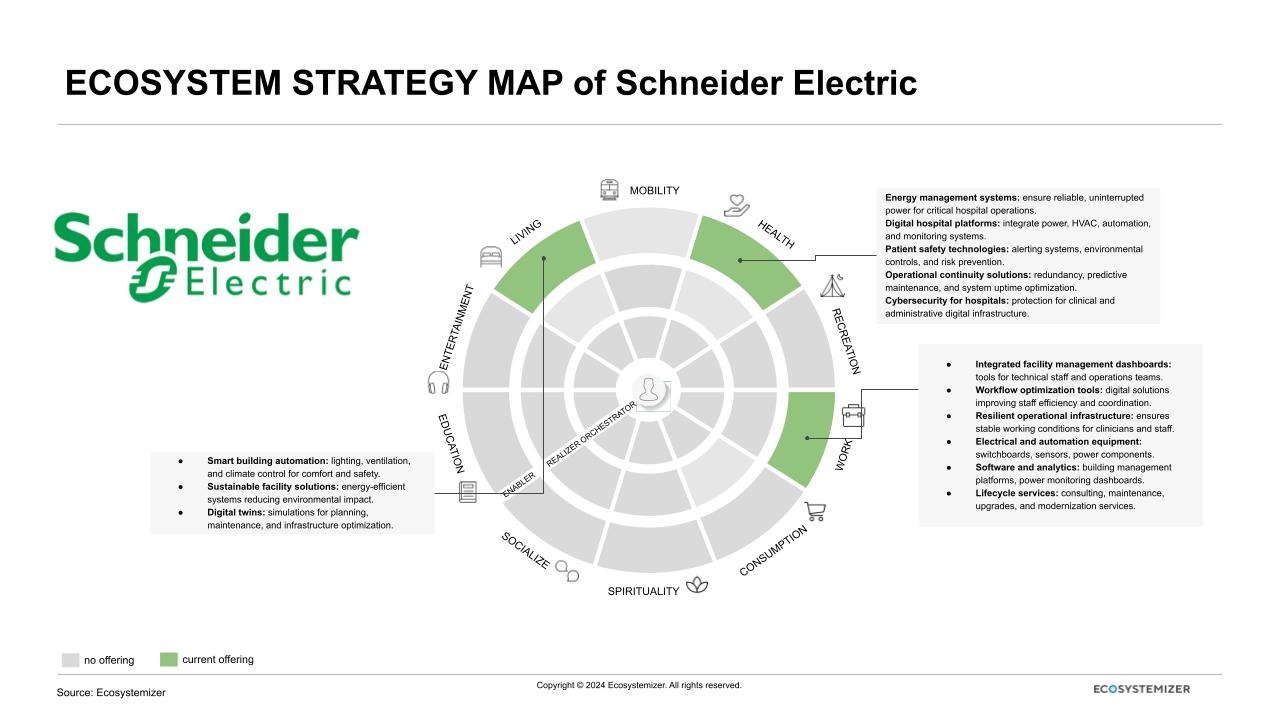
To understand the full extent of Schneider Electric’s healthcare activities, we map them using the Ecosystem Strategy Map (ESM). The ESM reveals the company’s positioning across Life Areas and Ecosystem Roles, providing a structured view of how Schneider Electric creates value beyond traditional industry boundaries.
The analysis shows that Schneider Electric primarily acts as an Enabler providing critical infrastructure, digital tools, and integrated systems that support hospitals in delivering safe, reliable, and sustainable care. In certain areas, Schneider Electric also assumes an Orchestrating Enabler role by defining standards for integrated hospital infrastructure.
The ESM perspective highlights how the company contributes to human needs such as health, safety, comfort, and productivity, while enabling a diverse network of partners to participate in the broader healthcare ecosystem.
Schneider Electric as a Blueprint for Healthcare Ecosystems
Schneider Electric demonstrates how companies can drive meaningful transformation by embracing ecosystem thinking. Through electrification, digitalization, and cross-industry collaboration, the company enables hospitals to operate with greater resilience, efficiency, and sustainability. The Ecosystem Strategy Map reveals how Schneider Electric’s solutions extend across multiple Life Areas, supporting patient care, enhancing work environments, and enabling long-term sustainability.
As healthcare systems continue to evolve, ecosystem strategies will become essential for delivering human-centered value. The Ecosystemizer Framework provides organizations with the tools to navigate this shift and design strategies fit for the ecosystem era.
Explore the Ecosystemizer Framework and learn how to design strategy for the ecosystem era.
.jpg)
