




The Strategic Crisis Many Mid-Sized Companies Face
Across Europe and beyond, many mid-sized companies - often world-class specialists in engineering, materials, biotech, or manufacturing - are quietly facing the same existential pressure:
- Global competitors are expanding faster.
- Product margins are shrinking.
- Innovation cycles tighten while differentiation becomes harder.
For many leaders, the key fear is not merely losing market share - it is losing their “right to play” in the future market, and their “right to win” through competitive advantage. The uncomfortable truth is: many Mittelstand and mid-market firms are structurally stronger than they appear, yet strategically weaker than they assume. Not because they lack capabilities. Not because they lack technology, know-how or manufacturing excellence.
But because they remain trapped in legacy business models while the sources of differentiation have shifted from products to branded components, ecosystems and collaborative platforms.
But there is a way out of this dilemma: there is a strategic opportunity that most companies do not have on their radar or at least significantly underestimate:
leveraging their unique capabilities & assets in an ingredient brand business model and embedding themselves into valuable ecosystems.
This strategic blend - Ingredient Branding + Ecosystem Thinking - turns what you make into what others need to grow. And when executed well, it becomes one of the highest-leverage business models available to mid-sized companies today.

Why Ingredient Brands Matter - Again (More Than Ever)
Ingredient Brands - from “Intel Inside” to “GORE-TEX®” - have long offered a powerful mechanism to:
- Command premium pricing, even in commoditizing categories.
- Shift perception from component supplier to essential co-creator of value.
- Build direct influence with end-users, even without selling directly to them.
- Shape category standards and ecosystem incentives.
But today, the opportunity is even greater:
- Ecosystems are replacing linear value chains.
- More products rely on specialized components, materials or technologies.
- Sustainability and regulation increase the value of trusted, certified ingredients.
- Consumers and businesses now proactively seek out “better inside” solutions.
When paired with Ecosystem Thinking, the Ingredient Brand does not simply enhance existing demand - it creates new demand by enabling new partnerships, new solutions, and new business models.
How to get there: Three Pathways to Ingredient-Driven Ecosystem Advantage
Below are three strategic pathways where Ingredient Branding + Ecosystem Thinking combine into future-proof, high-leverage business strategies.
Each includes examples and an analysis of why these companies are positioned to win. We showcase these pathways in order to demonstrate options on how other companies can act in the same way using a simple frame.
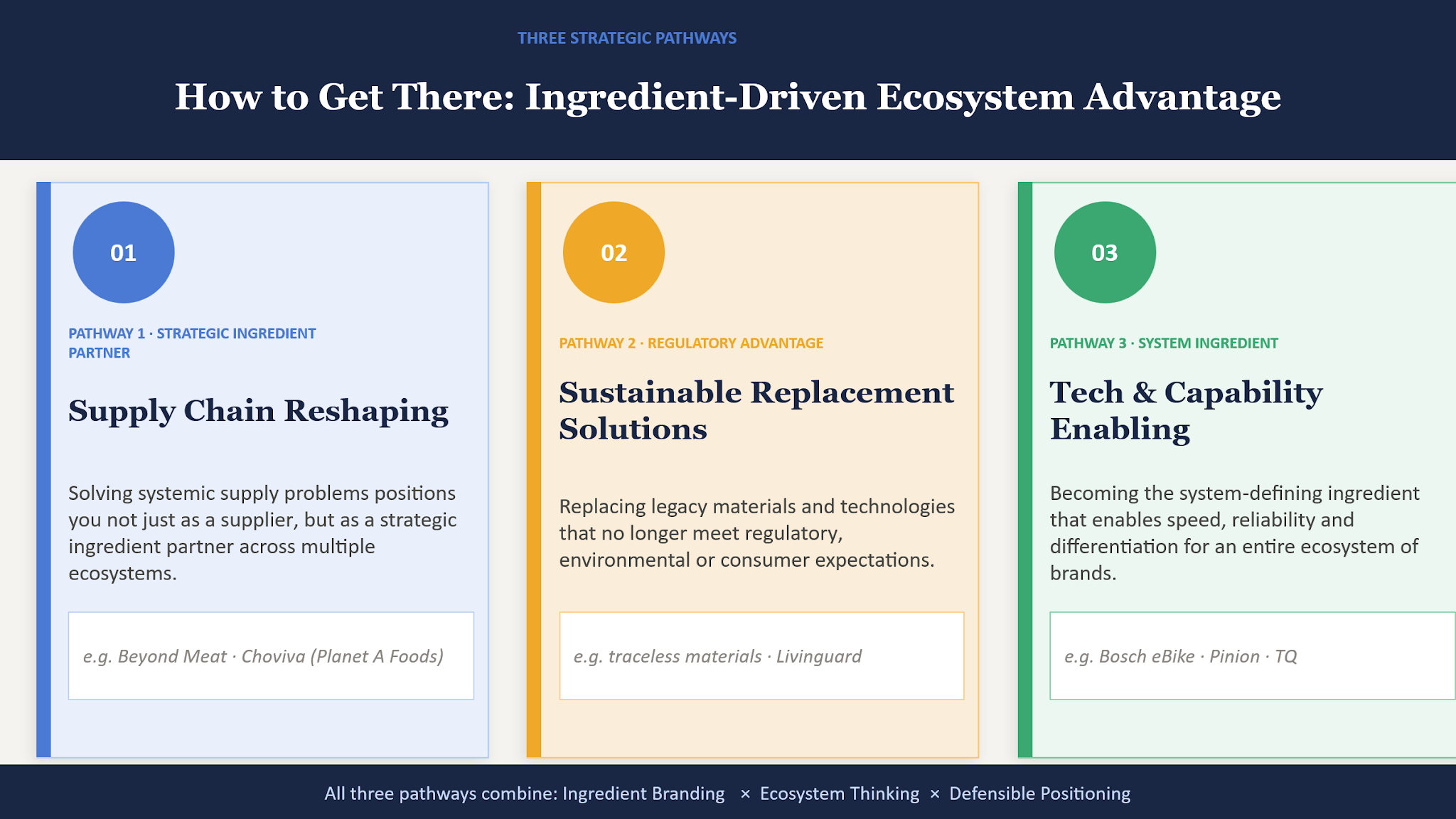
1) Supply Chain Reshaping: Beyond Meat & ChoViva
How consumer-powered ecosystems are repositioning former suppliers as a strategic ingredient brand partner
Few industries are currently undergoing a more profound ingredient transformation than food. Despite recent setbacks in the hype around food start-ups, healthy and sustainable nutrition remains one of the strongest growth markets. Climate pressure, raw material scarcity and regulatory scrutiny are forcing manufacturers to rethink the foundations of their products.
Companies like Beyond Meat and ChoViva represent a new generation of ingredient innovators that address these structural challenges directly. They show how solving a systemic supply problem can position a company not just as a supplier, but as a strategic ingredient brand partner across multiple ecosystems.
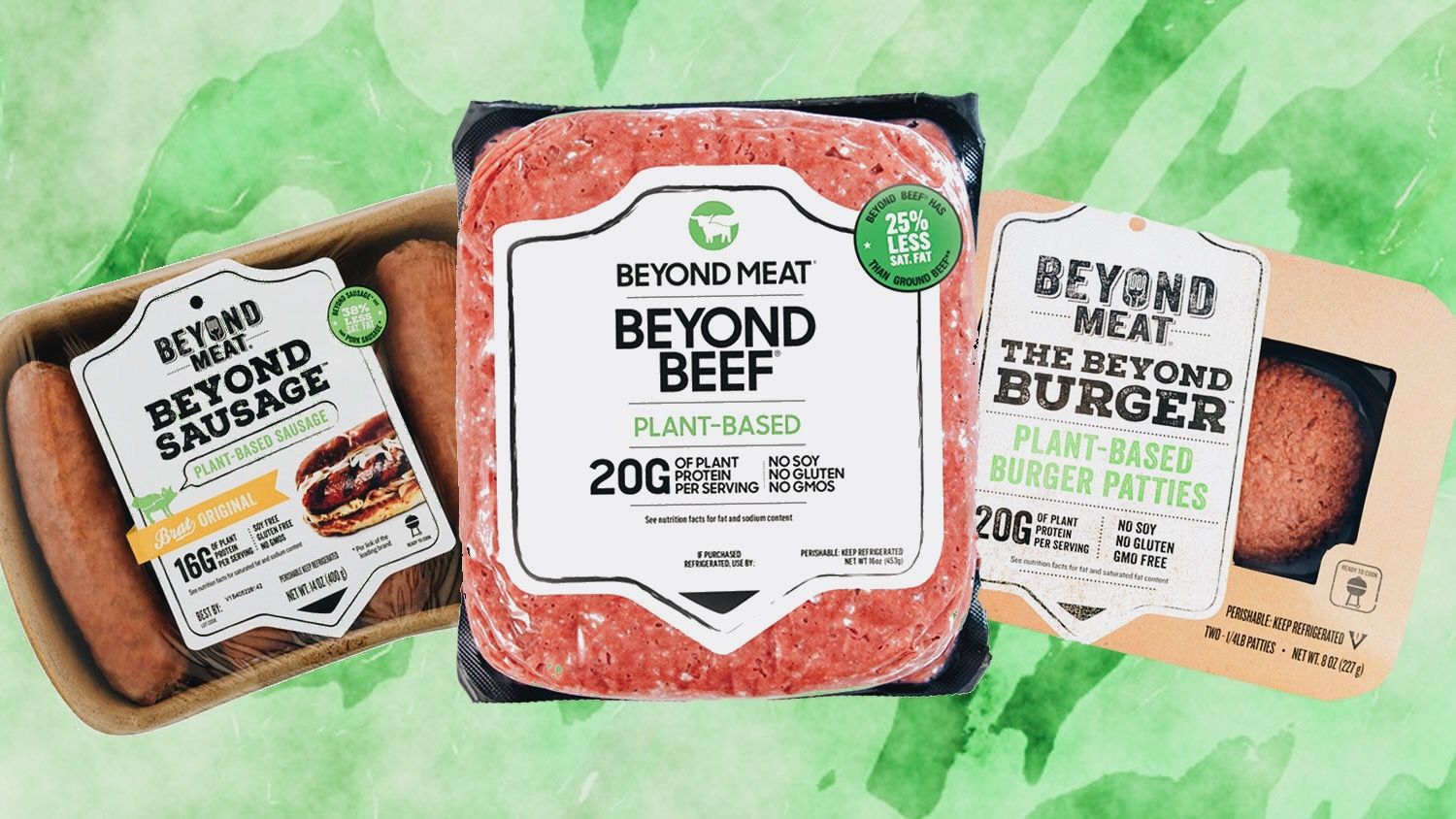
Beyond Meat - From Product Brand to Ecosystem Ingredient Brand
Beyond Meat develops and produces plant-based meat alternatives that replicate the taste, texture, and cooking behavior of animal meat, enabling food manufacturers, retailers and foodservice partners to offer familiar meat experiences with a plant-based protein base.
While Beyond Meat is widely known for its retail products, its next wave of relevance is increasingly tied to its ingredient-level capabilities: proprietary plant-protein formulations, texture engineering, and scalable production IP.
Why it works as an ingredient brand & ecosystem player:
- B2B expansion accelerates category adoption: fast food chains, meal-kit providers, universities, and food manufacturers increasingly rely on Beyond Meat as a plug-and-play protein module.
- Faster innovation cycles are enabled: Each partner becomes a co-developer, creating an ecosystem of applications (nuggets, mince, ready meals, new formats).
- Retailer bargaining power becomes less existential: By operating as an ingredient brand within multiple ecosystems, the company escapes the zero-sum logic of retailer negotiations. Once embedded across foodservice, private label and manufacturing ecosystems, the ingredient becomes harder to replace and less vulnerable to delisting or margin pressure
- Regulatory & sustainability positioning leveraged: As governments incentivize low-emission protein, partners prefer reliable, certified, globally recognized suppliers.
Strategic takeaway: Even a consumer-facing brand can unlock far greater resilience and category power by evolving into an ingredient branded ecosystem player.
ChoViva — The Sustainable Cocoa Alternative with Ingredient Brand DNA
ChoViva offers a cocoa-free chocolate alternative made from regional plant ingredients such as sunflower seeds, enabling food manufacturers and retailers to produce chocolate-like products with a significantly lower environmental footprint and reduced dependency on traditional cocoa supply chains. ChoViva, developed by Planet A Foods, is emerging as one of Europe’s strongest next-generation FMCG Ingredient Brand candidates.
Why ChoViva has exceptional ingredient brand potential:
- Structural risk mitigation: The cocoa supply chain faces volatility, inflation, climate threats, and labor issues. Manufacturers urgently need dependable alternatives.
- Superior flexibility: ChoViva can be formulated into chocolate bars, spreads, bakery products, confectionery coatings - acting as a “future cocoa” module.
- Co-branding opportunities: A “Made with ChoViva” claim enables manufacturers to signal sustainability, trustworthiness, supply resilience, and innovation.
- Ecosystem scalability: When large confectionery companies adopt it, others must follow - creating a network effect and rapid category expansion.
Strategic takeaway: When a product solves supply risk and improves sustainability and lowers cost, it is primed to become a high-pull Ingredient Brand.
2) Sustainable Replacement Solutions: traceless materials & Livinguard
How ingredient brands are powering the sustainable era
Across industries, sustainability is rapidly moving from marketing narrative to procurement requirement. Companies are increasingly forced to replace legacy materials and technologies that no longer meet regulatory, environmental or consumer expectations.
Ingredient innovators such as traceless materials and Livinguard illustrate how companies can seize this moment. Both address structural sustainability challenges while allowing downstream partners to maintain performance and scalability - making them strong candidates for next-generation ingredient brand ecosystems.
traceless materials — The Biocircular Plastic Alternatives Changing The Game
traceless materials develops fully bio-based, compostable materials made from agricultural plant residues that can replace conventional plastics in packaging and other applications. The company positions the material as drop-in for many plastics use-cases with fast compostability and without deforestation or food-competition concerns.
Why it is positioned for Ingredient Brand scale:
- Regulatory force is on its side: EU packaging and waste laws are accelerating non-plastic material adoption.
- Substitutability at scale: traceless materials is engineered to replace commodity plastics in packaging or single-use components - exactly the property buyers AND consumers want in an ingredient.
- Ecosystem pull: Brand owners like fashion, FMCG, and cosmetics seek solutions that satisfy sustainability targets without redesigning supply chains.
- Certification advantage: Material-level certification allows downstream partners to claim sustainability compliance with minimal complexity.
Strategic takeaway: When regulation, sustainability, and manufacturability align, a material solution has a natural pathway to Ingredient Branding.
Livinguard Better Fresh - The Textile Technology with Built-In “Better” Functions
Livinguard Better Fresh textile finishing solution combines leading odor control functionality – keeping textiles fresher for longer - with an innovative mechanism which reduces the shedding of microfibers over the entire lifetime of textiles.
Why Livinguard Better Fresh can become a leading ingredient brand:
- Functional promise that maps to buyer pain: textiles that smell fresh longer, and shed fewer microfibers solve clear consumer, brand and regulatory problems.
- Delivers invisible, high-value functionality: Sustainability, durability, and odor control are ideal for ingredient brand value propositions.
- Cross-industry relevance: From sportswear to workwear and fashion, an angle that bears potential to plug into many ecosystems.
- Premium co-branding potential: “Powered by Livinguard Better Fresh” can elevate partners’ product claims and create new relevance for consumers.
Strategic takeaway: Functional performance ingredients with cross-industry value multiplication are perfect for Ingredient Branding.
3) Advanced Tech & Capability Enabling: Bosch eBike & TQ
How tech players differentiate through system ingredient brands
In technology-driven industries, competitive advantage no longer comes from selling the “best component” alone. It comes from becoming the system-defining ingredient that enables speed, reliability and differentiation for an entire ecosystem of brands. However, ingredient branding is often the strongest - and least used - lever.
Bosch eBike Systems and TQ are prime examples of how advanced technical capabilities could be transformed into ingredient brands that sit at the heart of high-value ecosystems.
Bosch eBike Systems - The Reference Architecture of E-Mobility
Bosch eBike Systems has evolved from a component supplier into the leading system ingredient in the global e-bike market. Its motors, batteries, displays and software form a tightly integrated platform adopted by hundreds of bicycle brands.
Why Bosch eBike Systems works as an Ingredient Brand & ecosystem player:
- System-level value, not component value: Bosch does not sell a motor - it sells a complete, validated e-bike system (hardware, software, UX, service tools). For OEMs, this dramatically reduces development risk, time-to-market and integration complexity.
- Ecosystem lock-in through compatibility: Once a bike brand commits to the Bosch system, entire product lines, service infrastructures and dealer training programs are aligned with it. Switching suppliers becomes costly.
- Consumer pull reinforces B2B adoption: End customers actively ask for “Bosch-powered” e-bikes, turning the ingredient brand into a purchase driver and giving OEMs a strong sales argument.
- Platform economics scale innovation: Software updates, connectivity services and performance improvements benefit all ecosystem participants simultaneously - increasing the collective value of the Bosch platform over time.
Strategic takeaway: Bosch demonstrates how an integrated technical system and ingredient brand can become the default industry standard, anchoring an ecosystem that is extremely difficult to displace.
TQ E-Bike Systems - High-Performance Minimalism as an Ingredient Strategy
TQ’s lightweight, high-efficiency e-bike drive systems represent a different but equally powerful ingredient brand logic: invisible performance for premium, design-driven brands.
Why TQ has the potential to emerge as a next-generation Ingredient Brand:
- Enables a new product category: TQ’s ultra-compact motors allow e-bikes that look and ride like traditional bikes - unlocking new segments and brand propositions for OEMs.
- Engineering credibility as a trust anchor: Decades of experience in aerospace, robotics and high-precision engineering translate into strong B2B trust - a key prerequisite for ingredient brand adoption.
- Low-visibility, high-impact integration: The motor is almost invisible, yet fundamentally shapes the ride experience. This makes TQ a classic “hidden hero” ingredient with strong differentiation power.
- Selective ecosystem strategy: By partnering with premium brands rather than mass-market players, TQ maintains scarcity, brand prestige and pricing power within its ecosystem.
Strategic takeaway: TQ illustrates how focused technical excellence, combined with deliberate ecosystem choices, can create a defensible ingredient brand position even against larger competitors.
Across Bosch eBike Systems and TQ, a clear pattern emerges: The winners do not sell parts. They sell capability systems that others build their value propositions on. If you build something highly complex, difficult to replicate, safety-critical or integration-intensive, you might have a premium ingredient-brand opportunity waiting to be unlocked.
Conclusion: From Strategic Pressure to Strategic Relevance
Across all three pathways - Supply Chain Reshaping, Sustainable Replacement Solutions, and Advanced Technical Capability Ingredients - one pattern becomes unmistakably clear:
The most future-proof companies are not those that shout the loudest in the market, but those whose capabilities quietly power entire ecosystems.
In our advisory work with innovative scale-ups, established industrial players and global brands, we repeatedly see the same blind spot: companies underestimate the strategic value of the capabilities they already own.
Having built and scaled with GORE-TEX® one of the world’s most iconic ingredient brands over two decades and having studied and advised numerous future market readiness transformations, we know that the shift is rarely about inventing something new. It is about recognizing the ingredient brand potential that is already there and designing the right business model and ecosystem around it.
What This Means for Mid-Sized Companies Facing Strategic Pressure
If you are a CEO, founder, or shareholder of a mid-sized company, the core message is both confronting and encouraging:
You may already own an ingredient-enabled solution the world urgently needs - you just haven’t branded it, structured it, or ecosystem-enabled it yet.
The companies highlighted across pathways 1) to 3) show that Ingredient Branding, when combined with Ecosystem Thinking, is not a marketing exercise. It is a business model transformation.
Applied correctly, this combination allows mid-sized companies to:
- Identify hidden differentiators by looking beyond products and uncovering capabilities, materials, data, processes, or know-how that others depend on but cannot easily replicate.
- Turn internal competencies into external value multipliers by making them usable, reliable, and attractive for partners rather than keeping them locked inside the organization.
- Strengthen resilience through diversified downstream ecosystems, reducing existential dependence on single customers, industries, or dominant buyers.
- Command premium pricing through defensible positioning, because well-branded ingredients compete on trust, performance, and risk reduction - not on volume alone.
- Increase enterprise valuation by anchoring into multiple categories simultaneously, as the same ingredient can create value across industries, use cases, and growth cycles.
In a world where many mid-sized companies feel squeezed between global scale players and fast-moving startups, this model offers a credible way to reclaim strategic ground without outspending or outscaling competitors.
What Does It Take to Get There?
Becoming an Ingredient Brand and ecosystem enabler is not a branding project. It is a top leadership decision. The companies that succeed follow a fundamentally different set of principles.
1. Design for partners first, customers second
Ingredient Brands win when their partners win. This means designing offerings that integrate easily into partner systems, accelerate their time to market, and improve their differentiation - often before end customers ever see the ingredient.
2. Shift from brand ownership to brand stewardship
An Ingredient Brand lives inside other companies’ products and services. That requires shared governance, clear rules of use, and mutual value creation. Control is replaced by trust and consistency.
3. Turn your ingredient into an ecosystem node
A logo is never enough. Successful Ingredient Brands provide enablement: documentation, APIs or SDKs, training, performance data, certification, and ongoing support. The ingredient must be easy to adopt and hard to replace.
4. Prioritize trust infrastructure
Ingredients become valuable when they reduce uncertainty. Reliability, compliance, transparency, and performance guarantees are often more important than awareness. Trust is the true currency of ecosystems.
5. Measure network effects, not just brand lift
The most important question is not how well-known your brand is, but how effectively it accelerates an entire ecosystem. Success shows up in adoption rates, integration depth, partner dependency, and ecosystem growth - not just impressions.
A Final Thought: The Future Belongs to Businesses That Power Others
The companies shaping the next decade will not necessarily be those with the strongest consumer brands. They will be the ones whose technologies, materials, data, and capabilities make other companies possible - and successful.
Those are companies that combine Ingredient Branding with Ecosystem strategies. And many mid-sized companies are far closer to this model than they realize.
If you begin by identifying the capabilities that others cannot easily replicate - and then deliberately build the ecosystem that depends on them - you are already halfway to a future-proof business strategy.
If you are a mid-sized company fighting for relevance and long-term viability, remember this:
You do not need to outcompete everyone.
You need to become the company others build upon.
Your hidden assets may be tomorrow’s ecosystem engines.
Your components may be someone else’s differentiation.
Your know-how may be the missing link in a partner’s value chain.
The question is not whether you have this potential. The question is how long you can afford to leave it unused.
About the authors
Christian Langer is the founder & managing partner of KORE Advisors GmbH, the strategy consultancy strengthening organizations, teams, & brands from within (𝗸𝗼𝗿𝗲-𝗮𝗱𝘃𝗶𝘀𝗼𝗿𝘀.𝗰𝗼𝗺). For more than two decades, he shaped the global success story of one of the world’s most iconic ingredient brands in various key leadership roles – GORE-TEX®. As seasoned practitioner and advisor, he helps organizations in driving positive change and developing future-oriented business models.
Prof. Dr. Julian Kawohl is a Professor of Strategic Management at HTW Berlin (University of Applied Sciences), an author, speaker, senior advisor, and the founder of Ecosystemizer. Prior to his academic and entrepreneurial career, he was Head of Corporate Development at AXA Germany. As a thought leader in the field of future markets and business ecosystems, Julian supports companies around the globe with a unique combination of acadmic expertise and hands-on experience.
.jpg)
